Yes. You read that title right. The Cabbage has risen. What exactly is “The Cabbage” you may ask? The Cabbage is a nickname given to the eco-cottage. We are among one of the most sustainable cabins, 3/8 of our residents are vegetarian
Category: Uncategorized
Change and Small Steps
I think we can all agree that being eco-friendly is a good thing. I can’t think of many arguments in the contrary; in “green” lifestyles, the positive aspects far outweigh any sort of negative ones. Why, then, is it so uncommon to see people actively pursuing greener lives?
There is a definite stigma that comes along with being an environmentalist (even casually). After all, if you care about the planet, you’re a tree-hugging hippie.
Food Waste

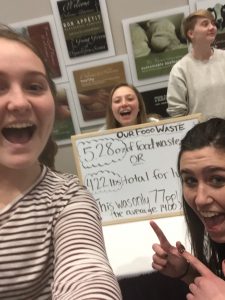
Last Wednesday, Thursday, and Friday in the DH, a few students showed the estimated statistics of how much food waste Furman University produces during lunch. I originally showed up to support my roommate, Celia, who was one of the students involved; however, after looking at the numbers, I really began thinking about how much waste I personally produce. I do not go out and buy food only to let it rot in the refrigerator, but I know that I probably do take too many plates of food in the DH. Of course my intention is not bad, usually I just cannot decide or think I am really hungry, but that does not justify the amount of food that I do waste. It is time to be more conscientious. Here are some solutions that I plan to use in order to fix the problem. Take less food. There is no point in taking three plates of food when I probably will not eat it all. More food is available, if the first plate was not enough. With that being said, take time eating. As I learned from the presentation, it takes twenty minutes for a person’s stomach to realize that it is full. Therefore, it is best to eat slowly so that I do not grab more food that I will not eat. I know that changing my habits alone will probably not have that much of an impact, but I am hoping that his blog post will inspire someone as Celia’s presentation inspired me.
Meat and the Environment
Let’s talk about meat.
In January of 2016 I woke up and decided I was going to see how long I could go without eating meat. I had no reasons, no personal motivation, and no interest in the idea of being a vegetarian except I just wanted to test my own willpower. It wasn’t until I was wondering on the internet one day that I found the motherland of reasoning, motivation, and promotion of vegetarianism that made me decide I never wanted to eat meat again.
So let’s talk about meat and the environment.
WATER USAGE:
It takes an incredible amount of water to produce a single pound of meat. It takes more than 2,400 gallons of water to make one pound of meat, whereas it takes 244 gallons of water to make a pound of tofu. A cow being prepped for slaughter will drink an upwards of 50 gallons of water a day. If one person goes vegan, that person alone can save approximately 219,000 gallons of water a year.
POLLUTION:
Runoff from factory farms and grazing is one of the largest contributors to pollution in rivers and lakes. Animals raised in captivity produce more manure per year than the entire country combined, and with no proper disposal method of this waste, it either sits in manure lagoons on the property or is sprayed over the fields. Furthermore, pollution limits are oftentimes limited by these groups by spraying liquid manure in the air, which is then carried to neighboring lands, where residents are forced to breath in toxins and pathogens from the manure.
LAND USAGE:
By using land to fuel the animal agricultural business, we are losing vast amounts of land to a unnecessary corporations. In the United States alone, 56 million acres of land are used to grow feed for animals to fuel the animal agricultural industry, whereas only 4 million acres are used to grow food for humans. More than 90% of all Amazon rainforest that has been cleared since 1970 has been used for grazing livestock. It takes approximately 20 times less land to feed a vegan than it does a single meat eater.
MORE INFORMATION I WANT TO SHARE:
The United States alone could meet the caloric needs of 800 million people using purely the grains that are used to fuel the animals in the animal agricultural industry. If we use that logic and apply it, even conservatively, to a few other countries with large animal agricultural industries we could meet the caloric needs of everyone in the world.
We do not need meat to survive. As much as I loved Cookout chicken tenders, eating meat was not worth the environmental impact. We have a limited number of resources in the world- water, land, air- and it isn’t logical to me to continue to kill animals for other animals to eat when we don’t need to and it is incredibly damaging for the environment.
YOU
Friday Night Sustainability
Living in the Greenbelt Community gives you opportunities to learn and practice sustainability during the week, but weekends are also a great time to extend sustainable habits into your free time, especially when it comes to partying. Here are some ways Adel and I have changed our weekend routines to be more sustainable.
- Getting Ready
- Perfumes and Cologne: Brief history lesson, until the production of Chanel No. 5, most perfumes didn’t contain synthetic ingredients. Afterwards, however, they became prevalent in most perfume brands. Organic perfumes are a lot more common than you would think. Even Rue21 has an eco-friendly line of perfume, and most brands that attempt to be more environmentally friendly will have labels.
- Other Products: You can use websites like the Skin Deep Cosmetic Database to check what harmful chemicals might be in your shampoos, conditioners, makeup, and other products.
- Clothes: If you’re worried about the carbon footprint of laundry, try not using to the dryer to lessen your impact. It’s better for your clothes, and you can reduce your emissions by more than half. Not using a dryer results in 0.7 kg CO2e if washed at 40°C and dried on a line. With a dryer, it’s 2.4 kg CO2e if washed at 40°C and tumble-dried in a vented dryer.
- Carpooling
- Carpooling with friends to parties or downtown Greenville is a great way to reduce vehicle emissions.
- Recycling
- Buying Beverages: Not so fun fact about the Greenville area, we can’t recycle glass. So if you’re buying soda, beer, liquor, or other beverages, try to buy plastic or aluminum so you can recycle it.
- Coffee: If you go to a Star Bucks for your coffee, and even other coffee places, you’ll notice that the cups and lids tend to have recycle symbols on them. Here in Greenville, our recycling center is perfectly capable of recycling the cups, but the plastic lids have a 6 within the recycling symbol, telling you what classification of material it falls under. However, this type of plastic isn’t recyclable in this area. Try bringing refillable cups to Star Bucks or other coffee places. Many offer great discounts if you do! In addition, for anyone who likes lattes or other milk-based drinks, try substituting dairy for soy or almond milk as a more sustainable and healthier alternative.
- Frat Parties: There’s nothing wrong with partying or drinking on the weekends, but frat parties off campus generate a lot of empty beer and soda cans. Try going to the house parties that recycle regularly, and if not, try suggesting recycling bins to the others.
- Restaurants:
- Try going to restaurants that serve local food. Though eating out does increase your carbon footprint, it’s still a good idea to support businesses that try to adhere to sustainable practices like sourcing locally grown foods. My main recommendation is Southern Pressed Juicery in downtown Greenville, which makes gourmet smoothies and acai bowls that are all vegan and made from locally grown ingredients. They’re really good!
Hope these tips were helpful! 🙂
Elon Musk: Addressing the World’s Most Pressing Challenges
At this stage in the development of human society, the extent of our effect as a species on the natural environment has still yet to be fully understood, but with the massive losses in biodiversity and alarming increases in both climate change and global nitrogen levels, the future does not present the brightest of images. While many still choose to debate the legitimacy of environmentally-related claims, primarily right-wing politicians with supposedly serendipitous financial ties to the oil industry, there are some who have opted to respond to the collectively bleak predictions of our future environment with a seemingly naive sense of proactive optimism. Elon Musk is one of them.
After earning nearly $200 million from the sale of his first company, PayPal, Musk immediately began working on three new projects that have each had gargantuan impacts on their respective industries. His most commercially relevant venture, Tesla Motors, was a project whose sole purpose was to “accelerate the advent of sustainable transport” by ultimately producing an all-electric vehicle that was unquestionably superior to all other vehicles of its class, while maintaining a consumer-friendly price point. After the company’s first three products, the Tesla Roadster, Model S, and Model X, the firm has finally announced its fourth and most exciting product to date: the Model 3. With a base price of roughly $30,000 and a standard 250 mile range battery, Tesla has quite possibly achieved the most revolutionary feat in the automotive industry since the invention of the internal combustion engine.
As for his second venture, SolarCity, Musk’s intention was to provide sustainable energy to homes by creating a lease-based system that would allow individual households to lease the solar panels necessary to provide enough energy to satisfy all of their power needs, which would ultimately cost the household considerably less money than the average monthly electric bill. Additionally, the household would have the ability to store any surplus energy that their panels may produce, given that they now owned their own energy supply as opposed to the energy supplied by their previous electric company. SolarCity was largely a success, but due to recent financial struggles, Musk decided to purchase the company with his other firm Tesla to operate SolarCity as a wholly owned subsidiary of Tesla. Tesla shareholders, although initially skeptical of the financial viability of the acquisition, have now come together in full support of the purchase.
Lastly, Musk’s third venture, SpaceX, is an aerospace manufacturer and space transport services company whose defining mission is to enable the human race to become a multi-planetary civilization. As a result of the high levels of risk and exorbitant costs required to operate a private company within the largely government-funded space industry, Musk faced a considerable amount of scrutiny in response to his decision to start SpaceX. However, after years of intensive work with some of the world’s leading physicists and aerospace engineers, Musk has defied all odds as he has continued to successfully operate the company while narrowly avoiding the ever-present threat of bankruptcy. The company’s arguably most revolutionary contributions to space travel have been the recognition of and response to the fact that well over 90% of the cost of space travel lies in the loss of the rocket after each flight, considering that the cost of fuel pales in comparison to the cost of a rocket. By introducing the concept of reusable rocket technology, Musk has reduced the cost of space travel by nearly one hundred fold by engineering rockets that have the ability to take-off and then land safely back on the ground after a flight. According to his predictions, Musk speculates that by the year 2060 there will be one million humans living in a sustainable community on Mars, but it is still far to early to accurately predict when exactly we will be able to expand human civilization to another planet. Nevertheless, the same radical optimism that Musk seems to all-too-eagerly apply to his lofty predictions has led him to achieve the monumental success that he has thus far.
-Noe Hinojosa
Kitties at Greenbelt
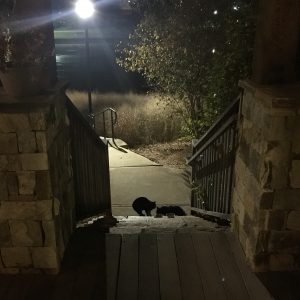
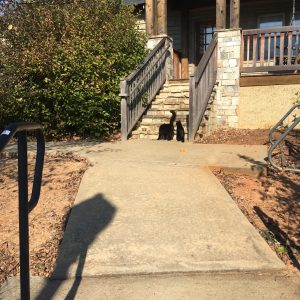
For me, life in Greenbelt is not only having three new roommates but also meeting three new kitties. I don’t know if Greenbelters have ever noticed or not that there are three (maybe more) kitties around us. I can see them walking in and out the woods, doing sunbath at the back door, frolicking with each other.
I LOVE kitties. I made a decision to feed them regularly the first time I saw them. Two of them are black and the other one is yellow. I haven’t given them name yet, so let’s do alpha, beta, and gamma currently. (I would really appreciate if anyone who can offer pretty names for them!) Alpha is the biggest and the fluffiest among the three. He is the friendliest one, though I still cannot pat him. It cost almost two months that he finally didn’t run away when he saw me. It eats a lot! When I placed the food on the stairs, alpha is always the first one rushing to the bowl, while the other two are extremely polite that they won’t even get closer to the bowl when alpha is eating. After alpha finished, beta, the smaller black kitty would move close to the bowl. It has brightening and smooth fur. It would come out from the bush immediately with alpha when I prepare the food. Unlike alpha, who can wait next to the bowl while I am pouring the food into the bowl, beta will run away even it knows that I am their friend and I won’t hurt it. Maybe it will take a longer time to let it get used to me. Gamma is the most unsociable kitty among the three. I will so lucky if I can see it once in a week.
As a Greenbelter, I need to follow some rules to live sustainable. Same for three kitties. They live in Greenbelt, then please have a sense of sustainability. I try to not feed them wet food that are used plastic package. If I feel that I need to offer them some treats, I’ll go for the metal package. More often, I bought a large recycled paper package of dried food, and also two stainless steel bowls. I pour then dried food into one bowl, and our some water into another bowl every day, which makes the kitties’ life more sustainable.


Be kind to the kitties,
Ruiwei
Furman Living Machine
In November 2009, Furman University put the “Sustainability Master Plan” into action to achieve it’s goal of meeting all of the LEED sustainability requirements for the Charles H. Townes Center for Science building. The LEED sustainability requirements are basically guidelines to making buildings more sustainable and having less of an impact on the Earth. For example, the big window in Hipp Hall is a LEED sustainability feature because it allows a certain amount of sunlight and heat to enter the building such that less heat and electricity needs to be generated.
A comparison of alternate waste treatment systems quickly established that “The Living Machine” was the most energy efficient form of waste management with the lowest life cycle costs. It works by pumping five thousand gallons of wastewater from a campus sewer into tanks underneath the greenhouse outside of Plyler Hall. The wastewater is then cycled between different cells where it is oxygenated. The nutrients from the wastewater allows for abnormally large plants to be grown and studied by Furman students and professors. After this water is cycled through, it is treated and disinfected by UV light and then reused inside the Townes Center for toilet flushing.
Exploring Greenville
If you have been in Greenville for more than two days, you have probably heard the phrase “Yeah that Greenville!”. I didn’t truly understand this phrase until I moved to Furman. Since I am from Virginia, I didn’t know a lot about Greenville when I moved here and so I was curious to learn all that I could about Greenville when I started school at Furman. Greenville is one of those places that is truly unique and is one that I have really grown to love during my time at Furman.
Over this past weekend, me and my friends decided to spend a day exploring Greenville. We just drove around exploring and found some new and interesting places in Greenville while doing so. While we were exploring we walked down part of the Swamp Rabbit trail, found a reclaimed skatepark, and visited some of our favorite hangout spots downtown (such as falls park). Just driving around Greenville really helped show me how many interesting parts of Greenville that I had never even seen before. It is really great to live in a place with so many unique opportunities and places. Greenville truly is my home away from home and I am so lucky to be able to go to school in such an awesome place.
Yours Truly,
Bella Metts