Seawater turns into freshwater through solar energy: A new low-cost technology

Tiffany Mendez

The world is running out of water. By 2025, it is predicted that nearly 2 billion people may not have enough drinking water to satisfy their needs. New NASA satellite data shows that a majority of the world’s underground aquifers are being worn out faster than they can be filled up. Since 1900, more than 50% of types of wetlands have disappeared and in many parts of the world, 40% of fresh water goes unaccounted for due to water leakage and pipe damage. One of the solutions to this problem is desalination. Desalination is a process that takes away minerals from salt water. However, removing salt from seawater will take up to 10 to 100 times more energy than traditional freshwater treatment methods.

A team of engineers was motivated by this problem and created a new prototype to desalinate seawater in a sustainable and low-cost way by using solar energy. This new device is predicted to double the amount of water used by solar energy. The proposed technology is simple: it was first inspired by plants, which transport water from roots to leaves by transpiration. The device is able to collect seawater using a low-cost porous material. The collected water is then heated by solar energy, which then separates the salt from the evaporated water. Unlike other active desalination technologies that need costly mechanical or electrical components such as pumps to desalinate water, the new proposed technology is based on spontaneous process, which means it does not need the help of machinery, and it is referred to as passive technology. Since it does not use pumps or costly machinery, the device is inexpensive.

This team has been able to reach record values of productivity: up to 20 liters per day of drinking water per square meter exposed to the sun. The main reason behind the performance is that it recycles the solar heat. This prototype is suitable for providing safe drinking water in emergency conditions, for example, areas where flooding and tsunamis occur. This prototype is also useful in third world countries where drinking water is scarce. In the future, the hope of this project is to collaborate with an industrial partnership to make this prototype more durable, accessible, and versatile. Freshwater is the most important resource for human life on earth. Without water, we cannot survive, and almost all our food sources require fresh water to grow or create. As water scarcity continues to present a major issue to society, it is important to take care of our planet and make sure we are doing everything we can to help save it from destruction.


https://www.businessinsider.com/nasa-data-shows-the-world-is-running-out-of-water-2015-6

https://wwf.panda.org/our_work/water/importance_value/

https://www.sciencedaily.com/releases/2019/01/190107131242.htm

Artist Statement – Dahye Kim

Dahye Kim

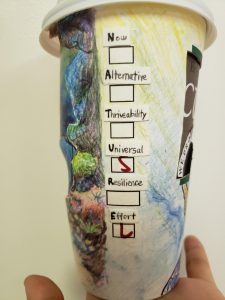
As coffee became an essential part of an urban lifestyle, easy disposing habits also became a routine for us. The motive for this piece was reducing coffee related waste. One of the largest coffee companies, Starbucks, produces six billion disposable cups each year. Most of the cups are used very temporarily and thrown away easily. While these cups are in our hands less than a day, it takes 20 years to decompose, and for the plastic lids, it takes more than 450 years to completely break down. Most of the waste that is not recycled or used ends up in the ocean, and they are busy invading the marine life.

In order to increase the awareness of disposable cups waste situation, this artwork demonstrates what the Ocean can look like if we produced less waste by bringing our own cups to drink coffee. The materials for this cup are a used Starbucks coffee cup and used Pepsi plastic bottle. Keeping the style of the coffee brand’s font and its arrangement was critical so that people would know what “Bring your own cup and… we proudly conserve” is targeting. Original words (for example, Decaf, shots, syrup…) to specify the types of coffee drinks were changed to the key qualities for a sustainable life. This also is an acrostic that makes the word “nature” when you read the first letters vertically. In order to increase visual aspect of the sea, the plastic bottle was cut and painted blue, which depicts deep blue sea surrounded by beautiful colors of corals reefs. Because of the reused plastic section, a candle was put into the cup to so it can be used as a decorative lantern.

The Environment, Plastic Bags, and You

Emilia Hyland

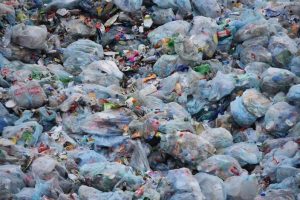
Plastic is a part of our everyday lives. An important topic is the use of disposable plastic bags and the effects their journey through our earth systems have on ecosystems. Plastic bags have not always been a part of our consumer culture. It was not until the 1970s that they were introduced in the United States and then in Western Europe in the 80s (Clapp & Swanson, 2009). Although they have only been a part of our culture for a couple of decades, their use has had a lasting impact on the environment already. To supply the demand of the 100 billion plastic bags used in the United States, 12 million barrels of oil are required (Clapp & Swanson, 2009). Oil is a fossil fuel that is nonrenewable and the emissions from its utilization attribute to numerous environmental issues, like climate change. Even their disposal has negative consequences because it is difficult since they are petroleum-based and therefore will not decompose for thousands of years in landfills, thus allowing for harmful chemicals to leach out into the surrounding environment. Recycling plastic bags is not a viable option either since the thin, petroleum plastic is not valuable enough to recycle. (Clapp & Swanson, 2009).

Figure 1: Plastic bags in landfill.


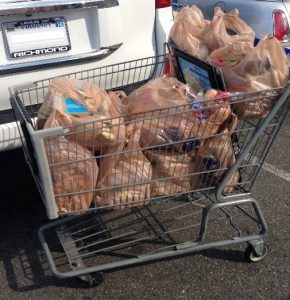
In many countries, plastic bags are given at no additional cost to the customers as they are purchasing their goods. Since they are quick and convenient, no one thinks twice about using them during their busy day to get from one point to another. At the end of their use, they are likely to be sent to the landfill or may be carried by the wind to another location because of their lightweight design. Plastics bags degrade at different rates depending on their composition and the location where they are dumped. They photodegrade, breaking down into smaller bits of plastic, which poses a threat to the animals that may consume the smaller pieces (Clapp & Swanson, 2009). There is no proper way of disposing of the plastic bags, so the only option is to reduce our consumption.

Figure 2: “Groceries in multiple plastic bag” by Peter Uetz licensed under CC BY-SA 4.0.

Solutions can range from individual action to the implementation of government policy. On the individual scale, one can bring their own reusable bags shopping. On a larger scale, policy reform can lead to positive social and environmental side effects, like taxing plastic bags to reduce consumption as it has been done in other countries. For instance, in Ireland a 15 Euro cent tax was imposed on plastic bags, which reduced the amount consumed and disposed by 90% (Convery, McDonnell, & Ferreira, 2007). A change in mindset may be required to make such a transition in America, but it is possible. Change will only happen with citizen participation in policy issues, so an individual can make a big difference by talking to their local representatives. Our plastic, consumer culture is the leading cause to harmful plastics in our environment, but by reducing our use of plastic bags through individual action and changes in policy, we might be able to reverse the harm we have already imposed and curtail future degradation.

References:

Clapp. J. & Swanston. L. (2009). Doing away with plastic shopping bags: international patterns of norm emergence and policy implementation. Environmental Politics, 18(3), 315-332.

Convery, F., McDonnell, S., & Ferreira, S. (2007). The most popular tax in Europe? Lesson from the Irish plastic bag levy. Environmental and Resource Economics, 38(1), 1-11.

The true cost of Recycling: is it worth it?

Spencer Jones

In 2002, in an attempt to save money and in a wake of government setbacks, New York’s Metropolitan Municipal works decided to no longer collect recyclables such as glass and plastics. Cutting back on recyclables ended up saving the city a total of $65 million. The system was flawed from the start with multiple routes and confusing sorting techniques and a lack of consumer education, so the city really had no other option. Eventually the citiy’s landfills began to fill, and suddenly the price of recycling became profitable, ending a two-year drought of recycling.

But what is the true cost of recycling? How much does your one misplaced bottle really affect the recycling program? Every day we are faced with a decision on where to place our leftover paper cup. However, there are so many issues on what goes where. The classic example is pizza boxes; these “would be recyclables” are often times covered in too much grease to truly be recycled, forcing workers to sort through tons of recycling. In some cases, if a batch is comprised of more than 20% of non-recyclable material, the batch is sent to the landfill.

The cost of recycling ranges from $20 to $50 per ton, depending on the route and location of the municipal facility. Reusing materials and products such as plastic is more economically sound than recycling glass; only 1/5th of the energy is saved from recycling glass, and hard plastics which require special bleaching and cleaning process to make viable again. Broken glass is one of the most difficult materials to recycle since shattered glass cannot be melted down to form another bottle. However, innovative companies are repurposing glass bottles into consumer products.

Aluminum, however, is the most recyclable product that we know of; more than 90% of cans and automotive parts are recycled. This is due to a mixture of supply and demand and educational efforts to recycle aluminum. Chances are that there is a 75% chance that the aluminum can that comes off the supermarket chance has been used before.


But why did NYC decide to cut recycling plastic and glass out of their daily recycle route? This is simply due to the fact that plastic and glass are really expensive to recycle and often times do end up in a landfill anyways despite being recycled. Plastic requires a lot of energy to melt down into the pellets it once was. However, eventually all plastics will return to the small hard beads from which the product was born. This period is considerably longer than we would like: roughly 450 years. Glass is by far one of the least profitable forms of recycling since materials to make new glass are much easier and more energy efficient than aluminum; since sand is readily available and cheap. Another challenge with glass is transportation and unknown structural strength within intact bottles. Most times with recycling glass, faculties just crush the glass until it is sand once more.  Some companies use this to make new bottles or it is used in other commercial ventures.


However, that one misplaced bottle can cause quite an impact to the recycling industry and sorting process. If glass is shattered in a paper container, that entire batch will be scrapped for workers safety. Since glass is relatively worthless to recycle, many municipalities won’t accept glass, but consumers still recycle it anyway. A North Carolina Municipal plant throws away about 30 to 40 tons of paper everyday due to contamination.


Recycling has become a key part of our social ecosystem and is encouraged for a sustainable future. Even though some objects are more recyclable than others, it is always better to reduce the amount of these products you buy and encourage reuse of ones that you do. Recycling is the last step and the least energy efficient out of the other two options in the recycle triangle we learned in elementary school. Recycling is expensive, but sometimes the materials saved and reused end up with a profit.


https://www.thoughtco.com/benefits-of-recycling-outweigh-the-costs-1204141

https://www.nytimes.com/2002/06/20/nyregion/new-york-city-budget-recycling-no-to-plastics-and-glass-yes-to-paper-and-metal.html

http://large.stanford.edu/courses/2012/ph240/micks2/

https://www.aluminum.org/industries/production/recycling

http://theconversation.com/why-cant-all-plastic-waste-be-recycled-100857

https://www.thebalancesmb.com/how-long-does-it-take-garbage-to-decompose-2878033

https://www.energycentral.com/c/ec/how-big-impact-does-recycling-make-environment

https://www.usatoday.com/story/news/politics/2017/04/20/weak-markets-make-consumers-wishful-recycling-big-problem/100654976/

Climate Change: The Importance of Hope

Ethan Kohrt

Among my generation there seems to be a strange sort of hopeless apathy about big issues. For many of us, we think our votes don’t make a difference, large corporations are too powerful to challenge, and the planet is racing swiftly and surely towards climate-induced Armageddon; surely there’s nothing that we can do as individuals to change things. Where did this sense of powerlessness come from? I’m not sure. But I think the best way to combat it is by spreading a message of hope. On the issue of climate change, this means reminding people that these problems have solutions, and that they are within the grasp of each one of us.

Some of this despair about climate change might come from the way the issue is most often framed: the typical persuasive piece I read recounts the myriad ways the global ecosystem is collapsing, then describes the cataclysmic future that awaits us if the trend continues, and closes with a plea for the reader to do… something. But despite being factually true and sensibly distraught, I see a big problem with this kind of argument. By focusing on the staggering scale of climate change and existential hopelessness of the current situation, it’s all too easy to frighten people into complacency. The problem just seems too big, and the solutions too far out of reach. I think that this theme has become so common in the media that instead of provoking action, ordinary people have started to become numb to it: thus the hopelessness. Something has got to change.

I believe that when we communicate about climate change, we have a responsibility to offer solutions that the audience could and would take part in themselves. A good way to do this is to use a method similar to “Graduated Exposure” in psychotherapy, whereby anxious people can overcome their fears and uncertainties. First break the issue into smaller parts; and then break the parts into a series of manageable steps, such that the first step has the lowest threshold, and the next is accessible from the first, and so on. For example, food production accounts for a decent portion of global emissions, and to lower emissions on this front everybody should ideally switch to a more sustainable vegetarian or vegan diet. Realistically, though, few people are willing or able to make such a drastic lifestyle change. So the problem needs to be simplified further; step one is to start by limiting the foods with the highest impact, beef and lamb. Perhaps limit consumption to once per week. Then, after some time eliminate them entirely, and set your sights on pork.

The point is, the idea of making a big and sudden lifestyle change can be pretty intimidating when viewed as a first step, but if you offer gradual steps leading up to it, people will find it much more appealing to begin the transition. This applies to every other aspect of the climate change issue; if you communicate in this way, people will think of it not as an unfathomable and insurmountable hurdle, but as a process in which they can directly make an impact. This little change in perspective might be the beginning of hope.


Carbon Footprint of Common Foods

https://www.bbc.com/news/science-environment-46459714

Graduated Exposure:

http://downloads.bbc.co.uk/headroom/cbt/graded_exposure.pdf

The Effect of Border Construction on Biodiversity

Rachel Knight

The building of Trump’s 5.5 meter (18-foot) wall plan will affect not only humans, but could potentially harm and endanger the surrounding ecosystems. 654 miles of existing barriers and walls were built with materials such as barbed wire to steel, bollard to wire mesh, and have already greatly affected the delicate ecosystems and wildlife on the border. President Trump favors construction of a border wall due to his value of strong immigration policies. The president has gone as far as shutting down the government in efforts to force lawmakers to provide $5 billion in funding. Illegal immigration was a central theme of his 2016 presidential bid, and he appealed to this issue by deploying 5,800 U.S. troops in 2018 to the border as immigrants from Central America desperately crossed into the United States.

Biodiversity on the border is threatened by this barrier wall, but the full effect has not yet been determined by scientists. A biologist at Penn State, Jesse Lasky, has attempted to assess the threat of the border wall. They estimated that, “134 mammal, 178 reptile, and 57 amphibian species live within about 30 miles of the line. Of those, 50 species and three subspecies are globally or federally threatened in Mexico or the United States.” Various threatened species on this border survive only because people on both sides have worked hard to conserve them.

The construction of this wall is expected to uproot a protected habitat of butterflies along the Rio Grande after the U.S. Supreme Court brushed off various environmental groups that wished to fight against this decision. Supreme court justices maintained District Court ruling to allow the Trump administration to overlook 28 federal laws for southern border wall construction, a few of which being the Endangered Species Act, the Safe Drinking Water Act and the Clean Air Act. It’s unsettling the lengths our president and the supreme court are willing to go to for this wall, purposely bypassing laws that are in place for significant reasons such as to protect our environment and species that risk extinction. It should appear obvious to the administration that by having to overlook this many laws, or any at all, should raise red flags and cause them to realize the potential detrimental effects constructing a border wall would have on the surrounding territory and its inhabitants. “I don’t think it’s understood [by lawmakers], and if it is, it’s discounted. ‘Oh, it’s just wildlife, big deal, they’ll figure out a way,’ or, ‘It’s the desert, there are no animals down there,’” said Kevin Bixby, executive director of the Southwest Environmental Center.”  This whole position of ignorance will have serious impacts on wildlife populations. It will prevent jaguars from coming back to the U.S., and some subspecies will disappear completely from the face of the Earth.

“Hundreds of thousands of butterflies housed at the nonprofit National Butterfly Center will be in jeopardy after about 70 percent of the center’s land winds up on the other side of the border wall,” according to the executive director of the center, Marianna Wright. Other concerns about this wall lie in the decline of the region’s ecotourism. Jeffrey Glassberg, the president of the center, predicts that visits will fall by half simply because it will cease to be a pleasant and peaceful place to visit. Lawsuits have been set in place against the government by three organizations, all led by the Animal Legal Defense Fund. Their claim is that construction of the wall would harm plants, wildlife and other species such as fairy shrimp and the Quino checkerspot butterfly.

With political and economic issues surrounding the border wall aside, continued construction of this wall will result in the bulldozing of land and sanctuaries that will negatively impact the volume and diversity of the species in this area by destroying their habitats or restricting access to areas containing essential resources for these species.


Citations:

https://www.rollcall.com/news/politics/ocelots-butterflies-border-wall

https://www.cbsnews.com/news/butterfly-sanctuary-in-texas-expected-to-be-plowed-over-for-trumps-border-wall/

https://www.vox.com/2018/3/28/17152644/trump-border-wall-texas-environment-refuge-butterflies

https://www.iflscience.com/plants-and-animals/trumps-border-wall-could-kill-texas-butterfly-sanctuary/

Artist Statement: George Antash

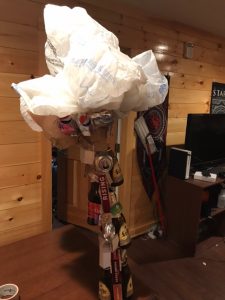
I decided to collect the trash that the Eco Cottage and the surrounding areas produced. When searching I attempted to pick out pieces that would both give the colors and textures of a tree trunk, but attempted to make sure I wasn’t too accurate because I wanted the final piece to be more of a representation of a tree. I tried to be extremely limited with the resources I used outside of our garbage; the only thing that wasn’t waste was adhesive. The sculpture went through many different changes when I started making it: first, my leaves were made out of metal and were scarce, however, this didn’t really help show that it was a tree. Eventually, the leaf design changed to plastic bags that were littering the area. I choose the shape of a tree because it is a universal symbol for the environment and it is recognizable enough that no matter what it is made of it is still recognizable. The point of the piece is to show that we can reuse and recycle trash to create new things as well as be eco-friendly.

Using the Last of the Liquid Explosive Dinosaurs – Fossil Fuel Consumption in 2019

Noah Barnes

What are Fossil Fuels?

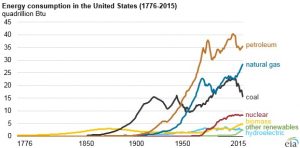
Fossil fuels are naturally formed fuels that originate from organic materials, such as plants and animals, and pressure from the Earth’s crust along with the passage of hundreds of millions of years.  These organic materials break down into crude oil, coal, natural gas, or heavy oils (sciencedaily). In most first world countries, fossil fuels are the leading sources of energy, dominating everything from household machines like cars or heating systems to industrial facilities. Figure (A) shows fossil fuel consumption in the United States over roughly the past 250 years, and it is not difficult to deduce that our consumption of these limited resources has grown exponentially in the past 100 years alone. Since so many processes rely on fossil fuels to function properly, we are consistently pulling these resources out of every nook and cranny we can find. There are two major problems with this mass extraction of resources: (1) these extraction processes can be extremely harmful to the environment, and (2) we are running out of fossil fuels.

(A)


What Effects does the Extraction of Fossil Fuels have on the Environment?

Coal, one of the most abundant and useful fossil fuels which has been used to power countless empires throughout history, harbors one of the most harmful methods of extraction:  mining and drilling. Over the past several decades, there has been a gradual shift from underground coal mining to surface mining (ucsusa). Underground coal mining carries less harm than surface mining due to the fact that underground mining is… underground. Surface mining involves methods like strip mining (a process that consists of overlaying soil to access the coal below) and mountaintop removal.  Because coal mining has only become more streamlined in the past two hundred years, the fact that we can do this faster only means that more habitats and environments will be destroyed.

Another primary fossil fuel on Earth is oil. When oil and gas are extracted, water that had been trapped in the geologic formation is brought to the surface. This “produced water” can carry with it naturally occurring dissolved solids, heavy metals, hydrocarbons, and radioactive materials in concentrations unsuitable for human consumption and difficult to dispose of safely (ucsusa). Due to the mass drilling taking place offshore, harmful toxins found in deeper water are being brought to the surface at an exponential rate. Not only is this water harmful to humans, but also to the habitats of surrounding ocean life. Additionally, pumping oil to the surface not only requires millions of gallons of water, but also 15,000-60,000 gallons of chemicals, many of which are undisclosed to Federal regulators. Researchers could track only 353 chemicals from that larger list and found that 25 percent of those chemicals cause cancer or other mutations, and about half could severely damage neurological, cardiovascular, endocrine, and immune systems (ucsusa).


What do we have planned for the Future?

Sustainable and renewable energy sources are a hot market right now due to the fact that people are finally becoming aware that we are running out of fossil fuels. This means that researchers and investors are constantly looking for new solutions or methods of clean, renewable energy. It may seem like the metaphorical “golden goose” of the modern world due to its seemingly too good to be true nature, but new energy sources are not unobtainable.

Solar and water power are not exactly new, but they aren’t old hat either. More hydroelectric dams – dams which produce energy based on the movement of water, like from a river – are being built across the country every day. Solar power has a bit of a social taboo due to the fact that it is an expensive and not extremely effective solution.  However, the Union of Concerned Scientists (UCS) is in the process of reviewing possible federal tax exemptions for those who use solar power to create a financial incentive for more people to use solar.  Geothermal and Nuclear energy are a little more volatile and a lot more expensive to maintain, however, the research and testing of these types of energy sources is just beginning, so it would not be unlikely for nuclear and/or geothermal energy to see a spike in both popularity and effectiveness in the near future.


What should we Conclude from this?

To conclude, fossil fuels are quickly becoming a limited resource, and we should expect to see most of them depleted within 100 years (ecotricity). While the harmful environmental effects of fossil fuel extraction may cease because of this (and this is something we should definitely be excited about), humans will still need new sources of energy when we run out of what we have been using. This is the uplifting bit – clean, renewable energy is on the rise not only in the United States, but in a conglomerate of energy-concerned countries worldwide. We will continue to experiment with what we have, pioneer what we can, and hopefully make a breakthrough for renewable energy as soon as possible.


Sources

https://www.sciencedaily.com/terms/fossil_fuel.htm

https://www.ucsusa.org/clean-energy/coal-and-other-fossil-fuels/hidden-cost-of-fossils#.XFOWnM17lPY

https://www.eia.gov/todayinenergy/detail.php?id=26912

https://www.ecotricity.co.uk/our-green-energy/energy-independence/the-end-of-fossil-fuels

(A) U.S. Energy Information Administration, Monthly Energy Review


Artist Statement: Kam JaCoby

I painted this landscape with the thought of global warming in mind. Science shows that there are roughly only twelve years for global warming to be kept under control until detrimental effects take place on the world. I look at this painting with hopes of a better future for our Earth and as a reminder of what the Earth used to look like before careless, unsustainable actions took place.

Does my one straw really matter?

Nataley Williams

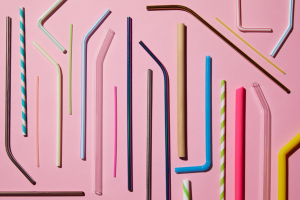
Last year, the food service provider at my college (Bon Appétit) banned all plastic straws on campus and replaced them with paper straws as a step towards campus sustainability. Their decision was a part of a larger national movement to phase out plastic straws. Companies such as Starbucks, Alaska Airlines, and McDonald’s are announcing plans to eliminate plastic straws by next year (A Brief). These companies are responding to the large outcry from activists who are demanding actions against the plastic straws that are harming the oceans. In America alone, 500 million straws are used daily, and a large portion of those are ending up in our oceans (Straw Wars). While I, as a Sustainability Science major, was happy about this transition, the campus reactions to the change were widespread. One question I heard over and over and often even asked myself as the paper of my straw withered away was, “Does my one straw really matter?”—in other words, is this one straw going to make a difference in the long run? Will any of my actions ever actually matter or have an impact at all?

That stream of questions occurs often in my head and in many others around me. With roughly 7.7 billion people in the world, it is easy to feel small and to think that your actions do not really matter on the grander scale. And really, your actions do not matter. As much as I hate to admit it, your one straw means little to nothing.

But your mindset does.

While one straw in itself may not matter, each person using just one straw equates to billions of straws. And while the transition to paper straws, even if it was global, will not solve any large sustainability issues, it is the mindset behind the movement that really means something. Large sustainability problems demand agency—the kind of agency that comes from knowing your straw doesn’t matter but acting sustainable anyway. If everyone believes their actions have no impact, then no actions will equate to the changes required. Conversely, if people see their actions as important, then that is how movements begin and persevere.

Many people also argue that globally banning all plastic straws will not result in a large change and that plastic straws are the least of our concerns regarding sustainability. While this is true, it is important to think how small changes can lead, and often do lead, to bigger and more important ones. The straw ban movement is a small step in an effort by many to eliminate single-use plastics, which are polluting our land and oceans. Even in the smallest way, consumers who are so used to the disposability of our current country might stop and think about why they are getting a paper or reusable straw instead of a plastic one. Those moments of questioning or consideration really matter to sustainability scientists because our major goal is to encourage conscious consumerism and push back against the planned obsolescence that our current society revolves around.

Often, sustainability activists must remind each other that our fight is a marathon and not a race. Important changes likely will never occur overnight, and it takes many years to see transitions to sustainability in society. But eventually, one straw turns into two straws and then into billions of straws.

“We know that just banning plastic straws will not be enough, but it’s a start. “Maybe you decide today to bring your reusable water bottle or mug with you, or you decide not to buy that cucumber that is wrapped in plastic. Every little bit helps.”